

Every few years somebody announces that search is dead.
This time the claim is that AI assistants like ChatGPT, Gemini, Perplexity and Google's AI Overviews will answer everything, and nobody will visit your website again. You have probably seen a version of it in your feed this month, usually followed by an offer to sell you the fix.
Some of it is true. Most of what people conclude from it is not.
Here is what has actually changed, what hasn't, how AI recommendation engines decide which businesses to name, and five things worth doing about it.

What Has Genuinely Changed in Search
Simple questions no longer need a click
Search for opening hours, a phone number or the meaning of a term, and you get the answer straight away, on the results page or from an assistant. You never land on the website.
That traffic is not coming back, and you should stop counting it as a loss. It was never worth much. Nobody looking up your opening hours was about to become a customer on that visit. They wanted your number so they could ring you, and that still happens.
Comparison questions get answered differently
Someone asking which type of system suits a business like theirs used to get ten links and read three. Now they often get a summary that names two or three options.
This is the change that matters. Being one of the named options is the new ranking first. Not being mentioned at all is the new page two. That is what people mean by AI visibility.

What Has Not Changed
People still search before they spend money
Nobody commits to a website rebuild, a security review or a year of advertising on the strength of a chatbot summary. They look up the company. They read the site. They check whether it seems real.
Those searches were always the ones worth having, and they are still happening. Traditional SEO still decides whether you show up for them.
People still want to know who they are buying from
An AI assistant can explain what infection control software does. It cannot tell someone whether your team will answer the phone in March.
That judgement is still made by a person looking at your website, and more and more by a person looking at your LinkedIn page and Google reviews too.
SEO, GEO and AI Visibility: The Terms in Plain English
You will hear a lot of new acronyms. Here is what they mean.
| Term | What it means | Where you show up |
|---|---|---|
| SEO (search engine optimisation) | Making your site easy for search engines to find, read and rank | Google and Bing results |
| Local SEO | Making sure you appear for searches tied to a place, such as "near me" or "in Manchester" | Google Maps, the local pack, AI answers about local businesses |
| GEO (generative engine optimisation) | Making your content easy for AI tools to understand, trust and quote | ChatGPT, Gemini, Perplexity, Google AI Overviews |
| AI visibility | How often AI tools mention or recommend your business | Any AI answer that names businesses |
They are not four separate jobs. GEO is built on SEO, and local SEO feeds both.
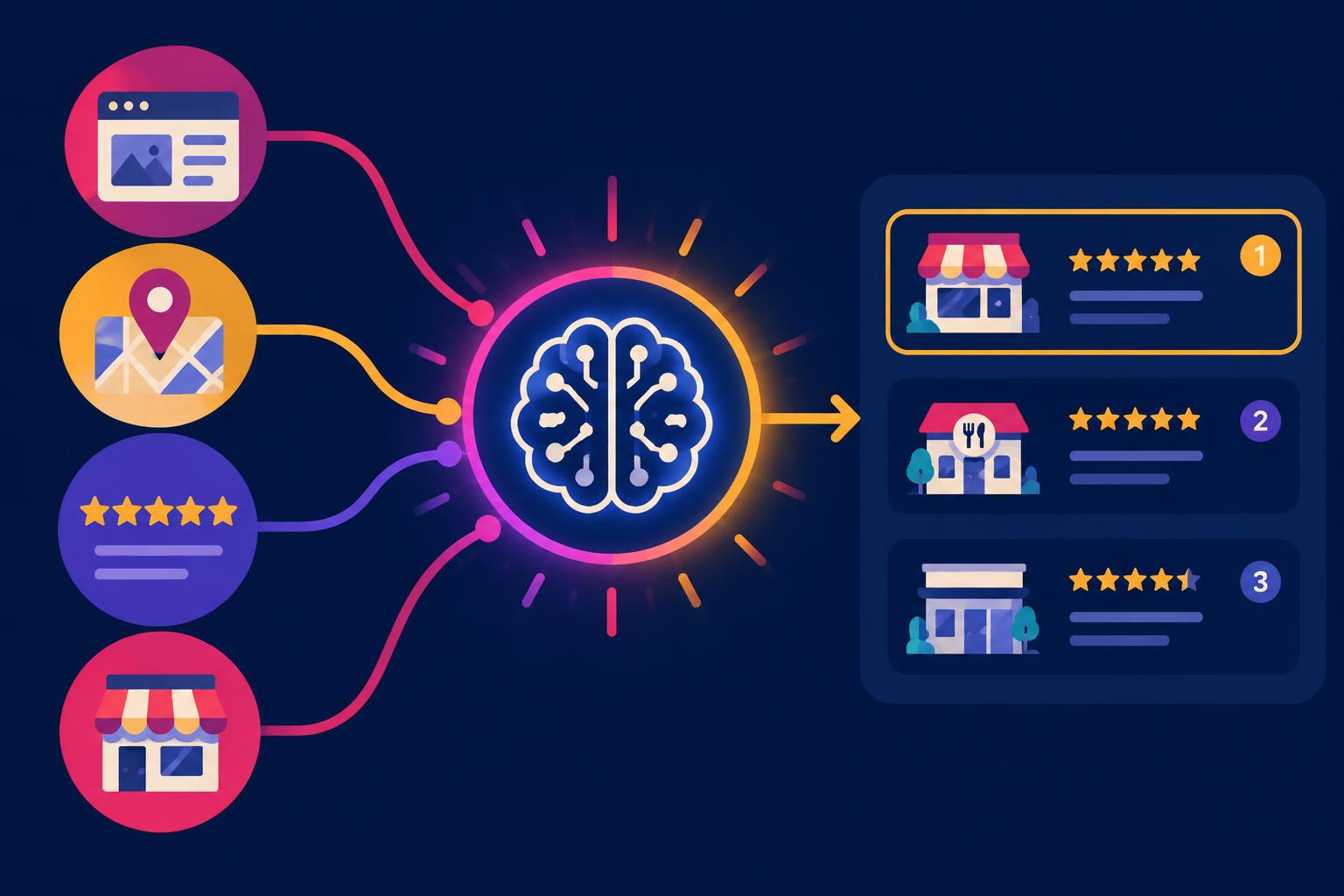
How AI Recommendation Engines Decide Who Gets Named
When someone asks an AI assistant to recommend a business, it acts as a recommendation engine. It pulls from websites, business listings, reviews and directories, then names the options it can understand and trust.
The short version: the same things that always worked, done properly.
- Clear writing. If a page states plainly what the service is, who it is for and what it costs, an AI model can extract that. If it opens with three paragraphs about your passion for excellence, there is nothing to extract.
- One topic per page. A page covering six services is hard for a model to summarise and hard for a person to read. That was always true. It matters more now.
- Real expertise. Content assembled from other people's content was already weak. Now it is worthless, because the AI does the summarising before anyone reaches you. What survives is what only you know: how the work actually goes, what goes wrong, what you would do differently.
- Consistent business details. Your name, address, phone number and description should match everywhere: your website, Google Business Profile, LinkedIn page and every directory. Contradictions make a business look less real to a model, and to a person.
Local SEO in the Age of AI Answers
Ask an assistant for "a reliable IT support company near me" and it has to decide which local businesses are real, open and well regarded. It leans on the same signals local SEO has always used.
- Your Google Business Profile. Complete categories, services, hours, photos and an accurate description.
- Reviews. Recent, genuine reviews that mention the service and the area give an AI something specific to repeat.
- Location pages. If you serve several towns, a clear page for each one helps both Google and AI tools connect you to that place.
- Consistent listings. The same name, address and phone number on every directory and social profile.
A business that is easy to find on Google Maps is usually easy for an AI recommendation engine to find too.
Five Things Worth Doing for Your AI Visibility
- Write down the questions customers actually ask you. Not keywords. The real questions, in their words. Then answer each one on your own site, one page per question, plainly. These are the passages AI tools quote.
- Check your own details. Open your website, Google Business Profile and LinkedIn page side by side. Make the name, description and contact details match. It takes half an hour and almost nobody does it.
- Fix the technical basics. Make sure your pages load quickly, work on mobile and can be read by search engines and AI crawlers. If a bot cannot read a page, it cannot recommend you.
- Separate brand from non-brand in your reporting. People searching your company name already knew you existed, and that number grows whenever anything else works. The number that tells you whether SEO is working is the other one.
- Stop measuring traffic alone. If informational visits fall while enquiries hold steady, nothing is broken. You have lost the visits that were never going to buy. Judge the channel on enquiries.
What Not to Panic About
You do not need to rewrite your whole website. You do not need a separate AI strategy, and you should be sceptical of anyone selling you one right now.
Most of what works for GEO is what worked for SEO: be clear, be genuinely useful, be easy to verify, and keep the technical basics in order.
The businesses getting named in AI answers are mostly the ones that were already well organised. That is not a coincidence. It is good news, because it means the work is the same work.
Frequently Asked Questions
Is SEO dead because of AI search?
No. People still search before they buy, and AI tools draw heavily on the same pages that rank well in Google. What has gone is low-value traffic from simple questions, not the searches that lead to enquiries.
What is GEO?
GEO, or generative engine optimisation, is the practice of making your content easy for AI tools like ChatGPT, Gemini and Perplexity to understand, trust and cite. In practice it means clear pages, one topic per page, real expertise and consistent business details.
What is AI visibility?
AI visibility is how often AI assistants mention or recommend your business when people ask relevant questions. Being one of the two or three businesses named in an answer is the new version of ranking first.
How do AI recommendation engines choose which businesses to recommend?
They favour businesses they can clearly understand and verify: clear service pages, consistent details across the web, genuine reviews and content that shows real expertise.
Does local SEO still matter?
More than ever. AI assistants answering "near me" questions rely on Google Business Profiles, reviews and consistent local listings, the same foundations local SEO has always built.
Get a Second Opinion on Your Site
IPRS Consultants has run marketing, engineering and security out of one team since 2017, through five Google core update cycles and the arrival of AI search.
Want to know where your site stands for SEO and AI visibility? We will look at it and tell you the three things we would fix first. Free, thirty minutes, whether or not you work with us.
Book Your Free 30-Minute Site Review