Key takeaways
- In 2026, IPRS put AI to work in four places: an AI-based CRM with an AI receptionist that calls and nurtures leads, automation from Marketing to Production, AI-assisted coding and testing with Codex and Claude Code, and GitHub skills for A/B testing and security checks.
- We trained our team in agentic AI, automations, GoHighLevel and strategic marketing in the age of AI.
- The biggest wins came from fixing the hand-offs between teams.
- In 2027, we're helping other businesses build AI into their ecosystem for a lasting competitive advantage.
It's 9:07 on a Monday morning in January 2026. A sales rep is scrolling through three inboxes to find out what a client said last month. A production planner is re-typing a brief from a PDF. Marketing is waiting on both of them for a number nobody has yet.
Nobody is lazy. Everybody is busy. And almost none of that work moves a customer forward.
That was IPRS at the start of the year. This post is the honest story of what happened next: what we built, what broke, and the seven lessons we'd share with any business starting its own AI transformation.
Why 2026 was the year to stop experimenting
By 2025, almost everyone was "using AI". Almost no one had finished the job. McKinsey's global survey found that 88% of organizations use AI in at least one business function, yet only 7% say it is fully scaled across the organization.
In 2026 the gap started to close, but unevenly. In McKinsey's latest survey, 44% of respondents now say AI is scaling across their enterprise, and 40% of large companies report scaling AI agents, while smaller organizations are stuck at 22%.
There was a warning too. Gartner predicts that more than 40% of agentic AI projects will be cancelled by the end of 2027 because of rising costs, unclear business value or weak risk controls.
So for a company our size, the question was never whether to use AI. It was how to land on the right side of both numbers: scale it like a large enterprise, and avoid becoming one of the 40%.
Where IPRS started: friction, not effort
Before 2026, our problem wasn't effort. It was friction.
Customer knowledge lived in too many places. Notes in inboxes, history in spreadsheets, context in people's heads.
Follow-ups depended on memory. One busy week, and a warm lead went cold.
Marketing and Production spoke different languages. Briefs were re-typed, status was chased over calls, and details got lost at every hand-off.
Good ideas didn't travel. One team built a useful script or prompt; the next team built it again from scratch.
We weren't alone. Salesforce found that sales reps spend about 70% of their time on non-selling tasks like admin and meeting prep.
Move 1: An AI-based CRM that does the admin
We started with the system closest to our customers. We moved to an AI-based CRM with one goal: the software keeps the records, and our people build the relationships.
What that looks like on a normal day:
Every interaction is captured automatically, so nobody types up a call after it ends.
Account briefings are ready before a meeting: history, open issues and a suggested next step in one view.
Leads are scored and prioritized, so each day starts with the conversations most likely to matter.
Follow-up emails are drafted for review, never sent without a person reading them.
Quiet deals get flagged before they go cold.
| Task | Before | After |
|---|---|---|
| Preparing for a client call | Search inboxes and spreadsheets | Read a one-page AI briefing |
| Logging a meeting | Typed up afterwards, if at all | Captured automatically |
| Following up | From memory | Drafted by AI, approved by the rep |
| Spotting at-risk deals | When the client goes silent | Flagged early by the CRM |
The wider market is moving the same way. Salesforce's 2026 State of Sales report says 87% of sales organizations already use some form of AI, and sellers expect AI agents to cut prospect research time by 34% and email drafting by 36%.
What surprised us: the AI was only as good as the data we gave it. We spent real time cleaning and merging records before go-live. It was the least glamorous part of the project and the most valuable.
Meet our AI receptionist
The CRM got a voice, too. Our AI receptionist answers and makes calls, so no lead waits for someone to be free.
Inbound calls:
Picks up every call, day or night, including weekends.
Answers common questions and finds out what the caller needs.
Books meetings straight into the team's calendars.
Logs a summary of every call in the CRM.
Outbound calls:
Calls new leads within minutes of an enquiry, while interest is high.
Follows up with leads who aren't ready yet, on a schedule, so they stay warm.
Sends reminders before meetings to cut no-shows.
When a lead is ready to buy, or simply asks for a person, the call goes straight to our team with the full conversation already in the CRM. Callers are always told they're speaking with an AI assistant.
We're not the only ones finding gold in forgotten leads. Salesforce says its own AI agents contacted 130,000 untouched leads and created 3,200 opportunities in four months.
Move 2: AI automation from Marketing to Production
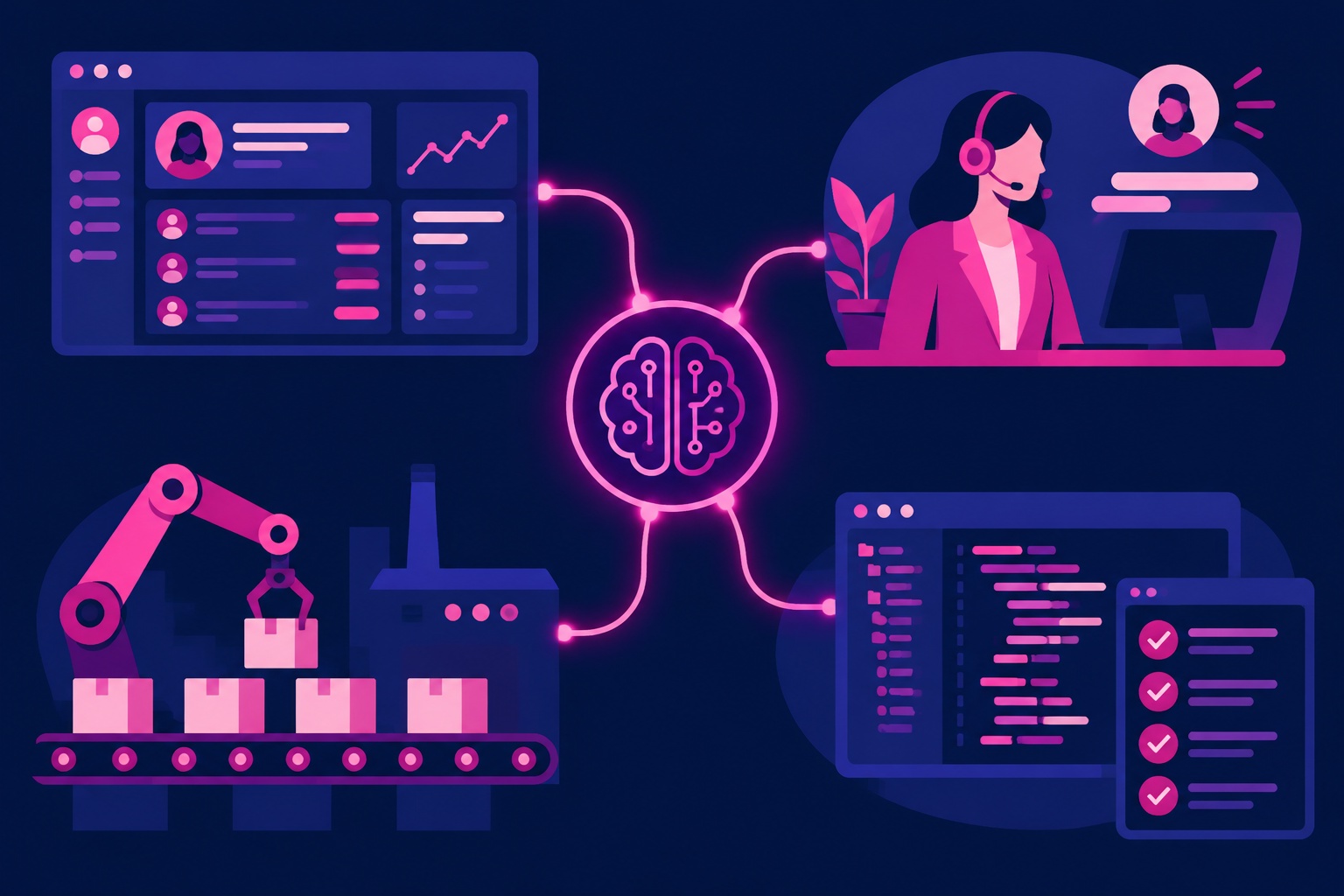
A better CRM fixes one team. We wanted to fix the gaps between teams. So we automated operations end to end, following a job from the first marketing touch to finished delivery:
Marketing: AI helps draft campaign content, build audience segments and summarize performance, so the team spends its time on strategy instead of assembly.
Sales hand-off: qualified leads arrive in the CRM with their full context attached. No client is asked the same question twice.
Planning and Operations: confirmed orders and briefs become structured job specifications, with scheduling suggestions ready for a planner to approve.
Production: status updates flow back automatically, and exceptions are flagged while there is still time to act.
Think of it as one continuous thread instead of four ropes knotted together. Fewer re-typed briefs. Fewer "where is this?" calls. Fewer surprises for clients.
This is where the industry is heading. Deloitte's manufacturing outlook cites a 2026 study in which more than 70% of manufacturers reported using generative AI and 66% were using or planning to use agentic AI.
One rule held throughout: people approve the decisions that matter. Automation moves the work; our team still owns it.
Move 3: Vibe coding and AI testing with Codex and Claude Code
Our software team changed how it builds, too.
What is vibe coding? You describe what you want in plain language, and an AI coding agent writes the code. You guide it, review it and test it. The term was coined by AI researcher Andrej Karpathy in early 2025.
Our developers use two coding agents, Codex from OpenAI and Claude Code from Anthropic, and pick whichever fits the task.
Here's how a new feature gets built now:
A developer describes the feature in plain English.
The agent drafts the code and the tests together.
The developer reviews it, asks for changes and runs it.
Nothing ships without a human code review.
How AI tests our software
Testing used to be the step that slowed every release. Now AI does the heavy lifting:
Writes tests with the code, so new features arrive already covered.
Finds the edge cases people miss, like empty fields, odd inputs and slow connections.
Reads failing tests and suggests a fix, instead of leaving a developer to dig through logs.
Runs the full test suite on every change before anyone merges it.
Our rule is simple: AI writes fast, people decide what ships. Vibe coding is perfect for prototypes. For production code, every line still gets a human review.
Move 4: GitHub skills for A/B testing and security
When a workflow works, we don't want it trapped in one person's head. So we package it as an agent skill: a folder with a SKILL.md file that teaches an AI agent one job, plus any scripts it needs. We keep these skills in our GitHub repositories.
Skills follow an open standard that more than 70 AI tools, including GitHub Copilot, now support. That means our skills work with Codex, Claude Code and whatever comes next.
Three skills made the biggest difference to our turnaround:
| Skill | What it does |
|---|---|
| A/B testing | Plans the test, writes the variants, sets the success metric and checks whether the result is real or just noise |
| Security assessment | Reviews code and settings against our security checklist before every release |
| Vulnerability analysis | Scans our code and third-party packages for known vulnerabilities, ranks them by risk and suggests fixes |
A note on security: these skills catch problems early and often, but they support our security experts rather than replace them. High-risk findings and penetration tests still go to a specialist.
Why keeping skills in GitHub works:
Every change is reviewed through a pull request.
Every version is saved, so we can roll back a bad update.
Every team uses the same library, so no one rebuilds the same tool twice.
7 lessons learned from our AI transformation
If you're planning your own rollout, this is what we'd tell you over coffee.
1. Start with the friction, not the tool
The projects that worked began with a bottleneck someone was tired of. The ones that stalled began with "we should use AI for something." It's also the surest way to stay out of the cancellation pile Gartner warns about.
2. Redesign the workflow, don't just speed it up
McKinsey's research shows that the companies getting the most value from AI are redesigning their workflows, not bolting AI onto old ones. Our biggest wins came from removing hand-offs entirely.
3. Clean your data first
AI amplifies whatever you feed it, including the mess. Budget time for data cleanup before go-live, and protect that time when the schedule gets tight.
4. Keep humans at the decision points
Automate the busywork. Keep people on approvals, pricing and anything a customer will see. It builds trust inside the team and with clients.
5. Train people, not just systems
Adoption was the real project. Short, hands-on sessions beat long manuals. Leaders visibly using the tools themselves mattered more than any memo.
6. Make every win reusable
A skill in a shared repository is worth ten clever prompts in someone's notebook. Our A/B testing and security skills were built once and now run on every project.
7. Measure before you launch, and expect version one to be wrong
Without a baseline, you can't prove the gain or spot a step backwards. And the first version will miss something. Ship it, watch how people actually use it, and adjust.
How we trained our team for the AI era
Tools don't change a company. People do. So alongside every rollout, we ran hands-on training inside IPRS, built around our own real work, not generic slides.
Four programs made the biggest difference:
Agentic AI: what AI agents are, where they help, where they don't, and how to supervise them safely.
Automations: how to map a manual process and automate it step by step, with a human check at every key decision.
GoHighLevel automation: building lead capture, follow-up sequences and booking workflows in GoHighLevel.
Strategic marketing in the age of AI: how AI search, AI-generated content and AI agents are changing the way customers find and choose a business, and how to plan for it.
The payoff: people stopped asking "what can AI do?" and started asking "what should we automate next?"
What's next for IPRS in 2027: helping businesses put AI to work
In 2026, we were our own test case. In 2027, we're taking what we learned to other businesses.
Our goal: help businesses navigate AI and build it into their own ecosystem, to create a sustainable competitive advantage.
Why sustainable? Anyone can buy an AI tool. The lasting advantage comes from the parts competitors can't copy overnight: clean data, redesigned workflows, reusable skills and a team that knows how to use them.
Here's how we'll help:
Find the starting point: an AI readiness review that spots the bottlenecks worth fixing first.
Plan the roadmap: a phased plan, with a measurable result for each step.
Implement: AI-based CRM, AI receptionist, automation from marketing to production, and AI-assisted software development.
Train your team: the same programs we ran inside IPRS, from agentic AI to strategic marketing in the age of AI.
Keep improving: ongoing support as the tools change, so the advantage keeps growing.
Inside IPRS, we'll keep going too: more connected data, more skills, and more automation across the business.
Frequently asked questions
What is an AI-based CRM?
An AI-based CRM is customer relationship management software that uses AI to capture interactions automatically, summarize account history, score leads and draft follow-ups. The aim is to cut admin so sales teams spend more time with customers.
How long does an AI transformation take?
It depends on scope and data quality. At IPRS, end-to-end automation rolled out in phases. Data cleanup was the step that most affected the timeline.
What are AI agent skills on GitHub?
Agent skills are folders containing a SKILL.md file that teaches an AI agent a specific task. Keeping them in GitHub repositories gives teams version control, review through pull requests, and one shared library that works across many AI tools.
What is vibe coding?
Vibe coding means describing what you want in plain language and letting an AI coding agent, such as Codex or Claude Code, write the code. The developer guides, reviews and tests the result. It's fastest for prototypes; production code still needs human review.
Can AI run security testing on its own?
No. AI skills for security assessment and vulnerability analysis catch common issues quickly and on every change, but serious findings and penetration testing still need a human security expert.
What does an AI receptionist do?
An AI receptionist is a voice agent that answers inbound calls and makes outbound ones. At IPRS it qualifies leads, books meetings, follows up with leads who aren't ready yet, and hands the call to a person whenever the caller wants one.
Can IPRS help my business implement AI?
Yes. In 2027, IPRS is helping businesses plan, implement and train their teams on AI across their whole ecosystem, from CRM and lead calls to operations and software, with the goal of a sustainable competitive advantage.
Will AI automation replace jobs at IPRS?
Our approach has been to automate repetitive admin and keep people responsible for decisions, approvals and client relationships.
Where should a business start with AI?
Start with one painful, measurable bottleneck, usually in sales admin or a hand-off between teams. Measure it, fix it with AI, prove the gain, then package what worked so other teams can reuse it.
Sources
McKinsey & Company, The state of AI in 2025 and The state of AI in 2026
McKinsey & Company, AI at work but not at scale
Salesforce, State of Sales 2026 and Sales AI statistics
Gartner, Over 40% of agentic AI projects will be canceled by end of 2027
Deloitte, Manufacturing industry outlook
Anthropic, Donating Agent Skills to the Agentic AI Foundation